Texas Board of Nursing rules for APRN clinical education, in plain words
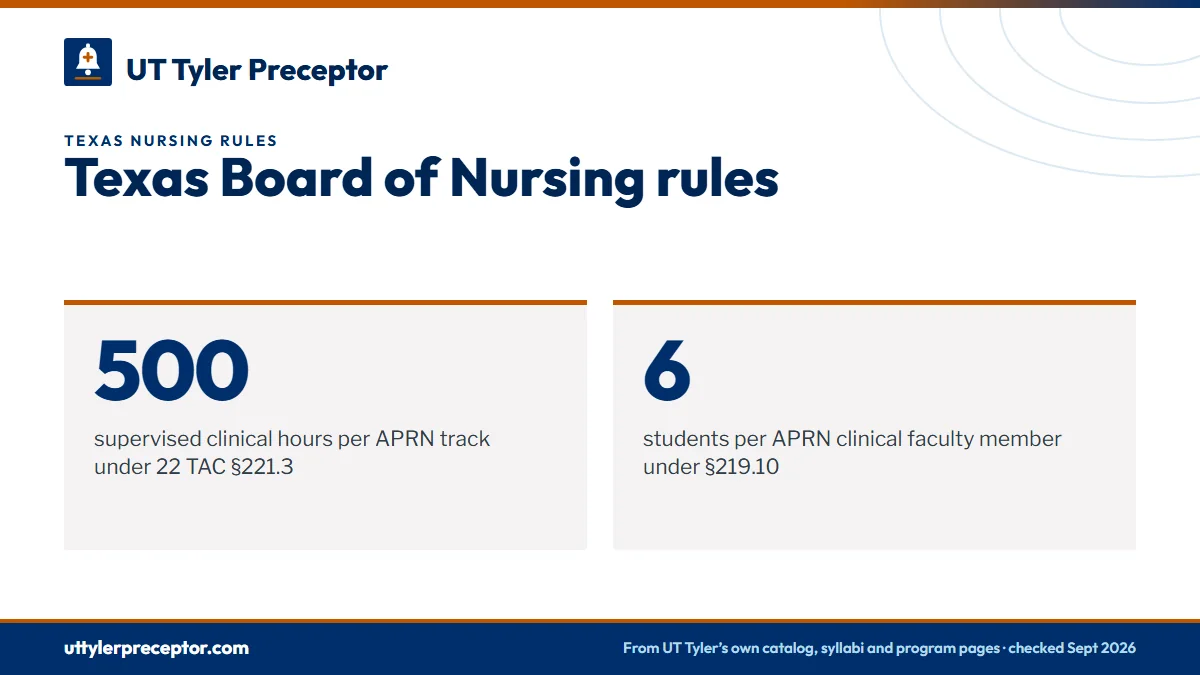
Texas Board of Nursing rules make faculty responsible for managing APRN students' clinical learning, require written agreements with preceptors and facilities, define a qualified preceptor and set a floor of 500 supervised clinical hours per APRN track. They do not say who must find an APRN student's preceptor. UT Tyler's process, in which students propose and faculty approve, operates inside that framework.
Find a preceptor who meets Texas and UT Tyler rules
Tell us your track and city, and your placement advisor checks each preceptor against both sets of rules before you file.
The rules that shape UT Tyler clinicals
Texas nursing education rules sit in Title 22 of the Texas Administrative Code, and the Nursing Practice Act sits in Chapter 301 of the Occupations Code. The rule text summarized here was read from Cornell's Legal Information Institute and from the Board's own copy of the Nursing Practice Act, as amended September 2023.
| Rule | What it covers | Where you meet it at UT Tyler |
|---|---|---|
| 22 TAC §219.10 | Clinical learning in APRN education programs | Faculty approval, the Preceptor Agreement, affiliation agreements |
| 22 TAC §219.2(19) | Definition of a qualified preceptor | Preceptor license and practice checks |
| 22 TAC §221.3 | APRN education that leads to licensure | Formal preceptorship and the 500-hour floor |
| 22 TAC §221.4 | Who may apply for APRN licensure | Texas or compact RN license |
| 22 TAC §215.10 | Clinical learning in pre-licensure programs | BSN placements and preceptors |
| Occupations Code §301.004 | Who the Nursing Practice Act covers | Student status and your RN license |
UT Tyler's NP Preceptor Guide, revised in January 2023, states that the School of Nursing follows 22 TAC §219.10, so that section is the one to understand first.
Section 219.10: faculty, sites and written agreements
Section 219.10 governs how an APRN program runs clinical learning, and in plain terms it says four things. Faculty carry responsibility and accountability for managing students' clinical experiences. Faculty choose and evaluate the facilities and practice settings used. A written agreement binding the program, the preceptor and, where one is involved, the facility spells out each party's duties. And one faculty member supervising a clinical course should have six students at most.
The rule also allows for distance. When visiting a site is not feasible, faculty can handle communication and evaluation by telephone, in writing or through clinical simulation.
At UT Tyler those pieces map onto named steps. Your Self-Placement Request proposes a site, faculty approve it, the preceptor completes the online Preceptor Agreement, and the school sets up a paper affiliation agreement with the facility. Affiliation agreements describes that last step in detail.
Who counts as a qualified preceptor
The Board's definition in §219.2(19) is broad on profession and specific on practice. A qualified preceptor may be an APRN, a physician or another health care professional the Board accepts. That person holds an active, unencumbered license, currently practices in the advanced role and population focus area, supports the APRN role, and supervises, teaches and evaluates the student in the clinical setting.
Section 219.10 adds that competent clinicians qualify when they are licensed as APRNs or are currently licensed health care professionals able to supervise and teach in settings suited to APRN education. That second group is how a physician, a physician assistant or, in some courses, a licensed therapist can precept.
UT Tyler adds its own requirements on top: Texas-licensed preceptors for PMHNP courses, a psychiatric specialty practice for PMHNP students, and an experience minimum that reads one year in the 2023 NP guide and two years on the online-program preceptor page. Preceptor requirements sets them out by track.
Chapter 221: the education behind an APRN license
Chapter 221 sets what an APRN's education must include to lead to Texas licensure. Under §221.3, preceptorships and similar experiences are planned and monitored by a designated faculty member or a qualified preceptor, programs last at least one academic year and include a formal preceptorship, and each track or major requires no fewer than 500 supervised clinical hours. Section 221.4 requires APRN applicants to hold a Texas RN license or a current privilege to practice as an RN in Texas.
The Board's licensure page restates the hour rule for anyone whose program ended in 2003 or later: a minimum of 500 distinct, non-duplicated clinical hours for every role and population focus. It also asks for national certification that matches your education.
Program totals can sit well above that floor. UT Tyler lists 750 hours for its FNP, PMHNP and AGACNP tracks, with some FNP cohorts on an earlier 675-hour plan, and Texas Center for Nursing Workforce Studies data for 2025 put median required precepted hours in Texas master's programs at 720 for FNP, 657.5 for PMHNP and 720 for AGACNP. Clinical hours breaks down UT Tyler's totals.
Students, licenses and the Nursing Practice Act
Occupations Code §301.004(a)(6) exempts nursing that is incidental to study in an approved program leading to a first nursing license. That exemption describes pre-licensure students. APRN students are already registered nurses who practice under their own license, which is consistent with UT Tyler requiring a clean Texas or multistate RN license before any APRN clinical hour.
Other Board touchpoints appear in UT Tyler policy. Policy 2.1 lets a student into a nursing course only with a clear background report or a Board letter certifying that any criminal history poses no danger to the public. Policy 2.2 notes that, under Nursing Practice Act §301.404, the school reports any enrolled student's positive drug screen to the Board. RN license requirements covers the license rules program by program.
BSN clinicals under Chapter 215
Pre-licensure programs follow §215.10. Written agreements with facilities must be in place before clinical learning begins, the faculty member supervises students and schedules their time and rotations, a preceptor may be responsible for no more than two students at a time, and BSN preceptors need a current Texas license or privilege to practice as an RN.
UT Tyler's undergraduate policy follows the same pattern, with faculty assigning clinical placements for BSN students in Tyler, Longview and Palestine. Policy 7.12 cites Board rules 214.9 and 215.9 when it defines what counts as clinical practice hours, a list that includes skills and computer labs, simulation, faculty-supervised care, clinical conferences and observation. Graduate NP clinicals work differently, and BSN clinicals explains the campus model in full.
What the rules leave open
No Texas rule or statute in this review assigns the job of finding an APRN student's preceptor. The rules make faculty responsible for selecting sites, approving preceptors and securing written agreements, and they say nothing about who does the searching. Schools therefore set their own approach, and UT Tyler's graduate policy leaves site choice to students, subject to their instructor's approval.
Chapter 219 itself applies, under §219.1(a), to APRN programs the Board approves until they gain accreditation from a national body the Board recognizes. UT Tyler's graduate nursing programs report CCNE accreditation and still state that they follow §219.10.
The Board also requires out-of-state nursing programs that plan clinical experiences in Texas to obtain its approval first. That page does not say whether graduate programs are included, and it concerns schools based outside Texas rather than UT Tyler.
Working within these rules
Our work sits in the space the rules leave to schools and students: the search. UT Tyler faculty keep every decision the rules give them, and your placement advisor makes sure what reaches them is complete. Before a preceptor's name goes on your Self-Placement Request, we check the points the Board's definitions and UT Tyler's own policies both turn on:
- An active, unencumbered license, matched to the preceptor's current role and population focus
- A facility ready to sign UT Tyler's written affiliation agreement
- Preceptor and site details full enough for faculty to evaluate the placement
- Timing that leaves room for approval before the semester begins
To start, share your track and city on the placement form.
Questions UT Tyler students ask
Can a physician assistant precept a nurse practitioner student in Texas?
Board rules allow it. Section 219.10 lets licensed professionals other than APRNs precept when they can teach and supervise in an appropriate setting, and the §219.2(19) definition names physicians and other professionals the Board accepts. UT Tyler's tracks add limits: FNP students are advised to log a quarter of their hours with APRNs, and a PA precepting PMHNP students needs a psychiatry CAQ.
Do Texas rules limit how many students one NP preceptor can take?
The APRN rule reviewed here sets a ratio for faculty, not preceptors: no more than six students per faculty member in a clinical course. The two-student preceptor limit in §215.10 applies to pre-licensure programs such as the BSN. Facilities and individual UT Tyler courses may set their own limits, so ask before planning to share a preceptor.
Do I need a Texas RN license to become a Texas nurse practitioner?
Board rule §221.4 is satisfied by a Texas RN license or by a current privilege to practice as an RN in Texas, which a multistate compact license provides. UT Tyler sets a higher bar at admission: its 2026-27 catalog wants a Texas RN license from anyone seeking APRN licensure, while its graduate page accepts a Texas or compact license for clinical hours.
Is 500 clinical hours enough to finish a UT Tyler NP program?
No. The 500-hour figure is the Board's minimum for licensure, counted per role and population focus. UT Tyler's NP tracks set their own totals above it, 750 hours in the current catalog for FNP and PMHNP and on the AGACNP program page, and graduation depends on meeting your program's requirement, not the state minimum.
How long does Texas take to process an APRN license application?
The Board's FAQ gives 10 to 15 business days as a typical review window. Before applying, expect to show an RN license valid in Texas, a finished program that satisfies Rule 221.3 and a national certification congruent with your NP education. Texas NP practice covers prescriptive authority after licensure.
Related pages
Last checked 2026-09-25
We check these pages against UT Tyler's own catalog, syllabi, program pages and clinical policies, and Texas rules. Your course, your program coordinator and the Clinical Coordinator have the final word.
UT Tyler asks you to choose your clinical site. We find it.
Tell us your UT Tyler track, where in Texas you live and when your next clinical course starts. We find preceptors near you who fit the course and gather everything your Self-Placement Request needs, so faculty can approve it before the semester.
- Preceptors matched to the course: pediatrics for
NURS 5453, adult and geriatric care forNURS 5455, psychiatric care forNURS 5367 - Texas-licensed preceptors who clear UT Tyler's supervisor, relative and site rules
- Anywhere in Texas, from the Piney Woods to the Valley
Start your placement plan
Program, city and start date is all we need to begin.