UT Tyler affiliation agreements: the facility contract that comes before your hours
An affiliation agreement is the contract between UT Tyler and the facility where you train, and it must exist before any clinical experience begins. UT Tyler handles it on paper with wet signatures, and a facility with no agreement yet can take weeks or months to sign one. Finding out early whether your site already has one is the simplest way to protect your start date.
Get your placement plan
Tell us your UT Tyler program and where you live. A placement advisor replies with preceptor and site options in your community that fit your UT Tyler course.
What the agreement is, and what it is not
Two agreements stand behind every UT Tyler graduate placement. The Preceptor Agreement is your preceptor's individual online yes, covered on the approval page. The affiliation agreement is an institutional contract between UT Tyler and the facility that governs students training there.
UT Tyler's NP Preceptor Guide says School of Nursing faculty and staff make sure institutional affiliation agreements, along with individual preceptor agreements, exist before any student clinical experience starts. UT Tyler's InPlace guide adds that the facility agreement is done on paper, with a wet signature, which is one reason it moves more slowly than the rest of your paperwork.
Texas rules for APRN education also call for written agreements among the program, the preceptor and the facility where applicable, spelling out each party's responsibilities. The state side is explained on Texas Board of Nursing rules.
No agreement, no hours, even at your own employer
The requirement reaches places students assume are exempt. A Fall 2026 DNP syllabus bars logging hours at any site, place of employment included, until the affiliation agreement is fully executed, and it asks DNP students to start and confirm the process with DNP faculty and the clinical placement coordinator well before any site-based work.
Working at a hospital does not tell you whether UT Tyler has a student contract with it, and it does not lift UT Tyler's conflict rules on supervisors and relatives. Those rules, track by track, are on clinicals where you work.
Fully executed means signed by both UT Tyler and the facility. Hours at a site whose agreement is still circulating for signatures do not count.
Why a new agreement takes time
An affiliation agreement is a legal document that both institutions review, and hospitals set their own pace. Their own student pages show the range, and several limit which schools they will add.
| Health system | What its student page says |
|---|---|
| CHRISTUS Health, system-wide | A written, signed Clinical Education Affiliation Agreement is required; its workflow steps average 30 to 60 days, and learners wait until it is fully executed |
| CHRISTUS Good Shepherd, Longview | Students confirm with their school that an active CHRISTUS agreement exists; preceptor applications are due 60 days before the rotation |
| University Health, San Antonio | New agreements average 6 to 8 weeks; the school must be physically based in Texas, and requests for a single student do not qualify |
| Children's Health, Dallas | New contracts take a minimum of three to six months, and for nursing it is adding affiliations only for current employees |
| Texas Children's, Houston | Licensed and APRN students submit an Affiliation Agreement Inquiry at least 6 months before the desired start |
| Hendrick Health, Abilene | An agreement comes first, and a new one may take several months |
These are each system's published rules, not statements about UT Tyler's current contracts with them. The Clinical Coordinator can tell you whether a specific facility is already covered.
When the facility already has an agreement
An existing agreement removes the slowest step, but it does not finish the job. The facility still runs its own onboarding. UT Tyler's InPlace guide describes an email of additional requirements for the site, notes that a site may need an Attestation Letter or Letter of Good Standing issued by UT Tyler, and warns that some places enforce deadlines of their own.
CHRISTUS Trinity Mother Frances in Tyler shows how a hospital process sits on top of the contract. According to its student page, students first verify an active CHRISTUS agreement with their school and must already have a preceptor, then send a resume and a copy of the preceptor's agreement while the school supplies a letter of good standing. Requests are due March 1, July 1 or November 1, and students re-apply each semester.
UT Tyler once offered a searchable InPlace list of facilities holding agreements, and its how-to guide now returns an error. Treat that list as history; the current answer comes from the Clinical Coordinator.
Private practices and small clinics
FNP rotations often land in clinics and private practices, and the Fall 2026 NURS 5349 syllabus will not approve hospital acute care hours at all. UT Tyler's guide holds those offices to the same standard as hospitals: the institutional agreement is in place before the experience begins. A practice that has not hosted UT Tyler students before will need time to review and sign UT Tyler's contract.
Ask early whether the practice has signed with UT Tyler before and who there handles contracts. Passing that contact to UT Tyler with your Self-Placement Request saves a round of emails. If the practice belongs to a larger health system, the contract may sit at the system level: CHRISTUS, for one, requires a written Clinical Education Affiliation Agreement between the whole system and each school.
How to keep the agreement off your critical path
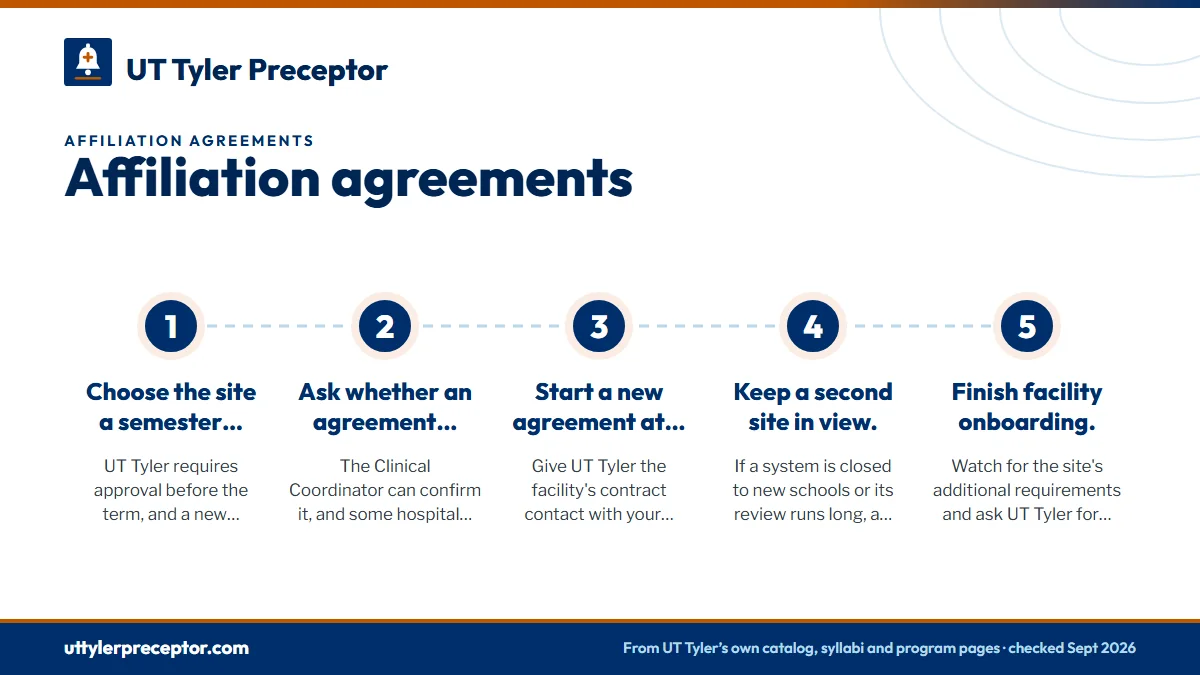
- Choose the site a semester ahead. UT Tyler requires approval before the term, and a new contract can outlast a short lead time.
- Ask whether an agreement exists. The Clinical Coordinator can confirm it, and some hospital pages tell you to verify it with your school before applying.
- Start a new agreement at once if one is needed. Give UT Tyler the facility's contract contact with your request, and tell faculty your start may depend on it.
- Keep a second site in view. If a system is closed to new schools or its review runs long, a backup keeps your semester on track.
- Finish facility onboarding. Watch for the site's additional requirements and ask UT Tyler for any letter as soon as the facility requests it.
How the placement desk shortens this step
We settle the contract question before we introduce you to a preceptor. Your placement advisor looks at how the facility takes students, what its own student page requires and how long its process runs, then favors sites whose timeline fits your semester. When a new agreement is needed, you know at the start, with the facility contact ready for UT Tyler.
If a system's page says it is closed to new schools, you hear that from us before you spend a week on it, along with open sites in the same area.
Through onboarding we keep the facility's list and UT Tyler's clearance steps side by side until you are cleared. See how it works, or give us your program and location through the placement request form.
Questions UT Tyler students ask
Does UT Tyler have affiliation agreements with hospitals near me?
UT Tyler does not publish a current list of facilities with graduate student agreements. The old InPlace facility search is archived and its guide returns an error. Ask the Clinical Coordinator about a specific site, and read the facility's own student page, since some list partner schools or tell you to confirm the agreement with your school.
Who signs a UT Tyler affiliation agreement?
It is a contract between UT Tyler and the facility, so the two institutions sign it, on paper with wet signatures according to UT Tyler's InPlace guide. Your part is to raise it early, give UT Tyler the facility's contract contact and keep your course faculty informed while it is pending.
How far ahead should I ask about an agreement?
UT Tyler gives no week count beyond approval before the semester, and its DNP syllabus says well in advance. Texas health systems' pages quote averages from 30 to 60 days up to three to six months for new contracts, so ask during the semester before your course, as soon as a site looks likely.
Is the affiliation agreement the same as the Preceptor Agreement?
No. The Preceptor Agreement is an individual online survey your preceptor completes after the Clinical Coordinator emails it. The affiliation agreement is an institutional contract between UT Tyler and the facility. UT Tyler's NP guide requires both before a clinical experience begins, and either one missing delays your start.
What if a facility will not sign an agreement with UT Tyler?
Then that site cannot host your hours, and you need another. Some Texas systems say on their student pages that they are not adding new schools, or only for current employees. Tell your faculty early and move to a backup site whose process fits your semester. See can't find a preceptor.
Related pages
Last checked 2026-09-25
We check these pages against UT Tyler's own catalog, syllabi, program pages and clinical policies, and Texas rules. Your course, your program coordinator and the Clinical Coordinator have the final word.
UT Tyler asks you to choose your clinical site. We find it.
Tell us your UT Tyler track, where in Texas you live and when your next clinical course starts. We find preceptors near you who fit the course and gather everything your Self-Placement Request needs, so faculty can approve it before the semester.
- Preceptors matched to the course: pediatrics for
NURS 5453, adult and geriatric care forNURS 5455, psychiatric care forNURS 5367 - Texas-licensed preceptors who clear UT Tyler's supervisor, relative and site rules
- Anywhere in Texas, from the Piney Woods to the Valley
Start your placement plan
Program, city and start date is all we need to begin.