UT Tyler MSN PMHNP and post-master's PMHNP certificate
UT Tyler's MSN Psychiatric-Mental Health Nurse Practitioner is 49 credits with 750 direct patient care hours, and the post-master's certificate is 34 credits with the same specialty courses and hours. Every clinical hour happens in Texas, in a facility and with a preceptor both licensed by the state. You choose the sites, faculty approve them, and this page sets out the courses and the clinical order.
Get your PMHNP placement plan
Tell us when your practicums start and your part of Texas. Your placement advisor maps the psychiatric preceptors each semester needs.
The PMHNP in brief
UT Tyler runs the PMHNP almost entirely online. The program page says all coursework is online except one hybrid course, and as many as two in-person clinical experiences at the Tyler main campus. You choose a two-year or three-year format, and the MSN has year-round starts.
Admission requires a Texas RN license. The program page adds that every practicum site must hold a Texas facility license and every preceptor a Texas license, whether a PMHNP, a psychiatrist (MD or DO) or a physician assistant with a CAQ in psychiatry. The syllabi go one step further: you, your preceptor and your patients must all be physically in Texas. Texas-only clinicals explains where that rule comes from.
Graduates sit the ANCC PMHNP-BC exam. UT Tyler reports a first-time PMHNP pass rate of 100% for 2024.
Every course in the MSN PMHNP
The order below follows the catalog's BSN-DNP PMHNP outline, which uses the same specialty sequence as the MSN. Credits follow UT Tyler's rule that a course number's second digit gives its credit hours.
| Course | Title | Credits | Clinical hours | Sequence |
|---|---|---|---|---|
NURS 5301, NURS 5302, NURS 5321, NURS 5324, NURS 5325 | MSN core | 15 | 10 practice hours each | 7-week Flex sessions |
NURS 5350 and NURS 5352 | Advanced Pathophysiology; Advanced Health Assessment | 3 each | Lab only | Semester 1 |
NURS 5354 and NURS 5111 | Advanced Pharmacotherapeutics; The Advanced Practice Role | 3 and 1 | None | Semester 2 |
NURS 5357 and NURS 5359 | Neurobiology Overview; Psychopharmacology | 3 each | None | Semester 3 |
NURS 5363 | Differential Diagnosis of Mental Disorders Across the Lifespan | 3 | Clinical course; hours not published | Semester 4 |
NURS 5365 | Psychotherapeutic Theories and Modalities | 3 | Clinical course; hours not published | Semester 4 |
NURS 5367 | PMHNP Practicum I (adult and older adult) | 3 | 125 | Semester 5, with NURS 5368 |
NURS 5368 | Integrated Mental Health Care I (Adult/Gerontology) | 3 | 125 | Semester 5, with NURS 5367 |
NURS 5370 | PMHNP Practicum II (children, adolescents and families) | 3 | 125 | Semester 6, with NURS 5373 |
NURS 5373 | Integrated Mental Health Care II Capstone | 3 | 125 in the catalog | Semester 6, with NURS 5370 |
| Total | 49 | 750 in the catalog |
The four named practicums account for 500 of the 750 hours. The catalog lists NURS 5363 and NURS 5365 as the program's other clinical courses without printing their hours, so read each syllabus in Canvas when you enroll.
The clinical sequence: paired practicums
Most of the PMHNP's direct care comes in two semesters. Each practicum pair is a set of co-requisites taken together in one 15-week semester, which puts 250 hours into a single term, or roughly 17 hours a week if spread evenly by our arithmetic. The diagnosis and psychotherapy courses come first.
| Stage | Courses | Population or focus | Preceptor |
|---|---|---|---|
| Semester 4 | NURS 5363 and NURS 5365 | Diagnosis across the lifespan; psychotherapy | For NURS 5365, therapy preceptors may include an LPC, LCSW, LMSW, psychologist (PhD or PsyD) or LMFT |
| Semester 5 | NURS 5367 with NURS 5368 | Adults and older adults | A PMHNP, psychiatrist or PA with a psychiatry CAQ |
| Semester 6 | NURS 5370 with NURS 5373 | Children, adolescents and families, plus the capstone | A preceptor whose caseload includes children and teens |
NURS 5370 also has a pediatric floor: 15 or more hours with children up to age 12, plus 50 or more encounters with 12- to 17-year-olds. The course-level rules are on the psychiatric practicums page, and the semester 4 clinicals have their own page, diagnosis and therapy hours.
Rules that decide who can precept you
The PMHNP syllabi spell out a long list of placement rules. Check a site against every one of them before you ask a preceptor to commit.
- Four approvals before the first hour. Exxat clearance, clinical site approval, schedule approval and faculty approval, every clinical semester. Expect a day or two for faculty to approve your start.
- Texas throughout. Preceptor, student and patients in Texas, at a Texas-licensed facility.
- Mostly PMHNPs. Psychiatrists and psychiatry-CAQ PAs qualify as primary preceptors, though PMHNPs should supervise the bulk of your time.
- Two rotations per preceptor. Any one preceptor can cover two rotations at most across the whole program.
- 125 inpatient hours. A program-wide minimum, so plan at least one inpatient block early.
- Telehealth cap. No more than 63 telehealth hours in any clinical course.
- Population fit. 80% of a course's hours should relate to that course's population focus.
- No relative, employer or direct supervisor. Inside your employer's system, clinical time has to happen away from your own unit or service line, with another manager, another approved preceptor and none of your job duties. See clinicals where you work.
- Pace limits. No more than 11 hours in 24, no start on the first day of class, and no clinicals over university holidays, breaks or finals week.
Exxat clearance alone does not let you start. The PMHNP syllabi require site, schedule and faculty approval as well, every semester, and hours logged before all four approvals will not count.
The post-master's PMHNP certificate
The certificate is 34 credits for nurses who already hold an MSN: the same 12 specialty courses and 750 clinical hours as the MSN, minus the MSN core courses. It starts in fall or spring, with the same admission rules and deadlines as the FNP certificate. You need the master's degree, a Texas RN license and one year of full-time direct patient care within the last four years, and applications close June 15 for fall and November 1 for spring.
Earlier courses in advanced pathophysiology, health assessment and pharmacology are reviewed rather than accepted automatically, and the catalog adds that a single course combining the three will not substitute for them. The certificate page states the location rule directly: because every clinical hour is in Texas, every student needs a valid Texas license.
Certificate students join the same practicums as MSN students, so the paired sequence, the inpatient minimum and every preceptor rule on this page apply the same way.
Where UT Tyler's PMHNP documents disagree
A few PMHNP details differ between UT Tyler sources. None changes the overall plan, but check each against the syllabus for your own term.
NURS 5373is 125 hours in the 2026-27 catalog and 135 in the 2023 NP preceptor guide. The catalog is the newer source.NURS 5363andNURS 5365count as clinical courses in the catalog, with no published hours.- The
NURS 5373syllabus asks for clinical logs within 48 hours of each shift in one place and within 72 hours in another. Logging within 48 hours meets both. - The same syllabus places the first preceptor meeting within the first week in one line and within the first six weeks in another.
- Some UT Tyler pages still point to InPlace, while the Fall 2026 PMHNP syllabi use Exxat for clearance and hours.
How we plan a PMHNP placement
Texas is short of mental health clinicians: HRSA's June 2026 shortage data show 412 mental health shortage designations in Texas with about 32% of practitioner need met, and the PMHNP rules narrow the preceptor pool further. We plan every clinical semester at once, so the inpatient block, the pediatric caseload for NURS 5370 and a fresh preceptor for your later rotations are lined up before you need them.
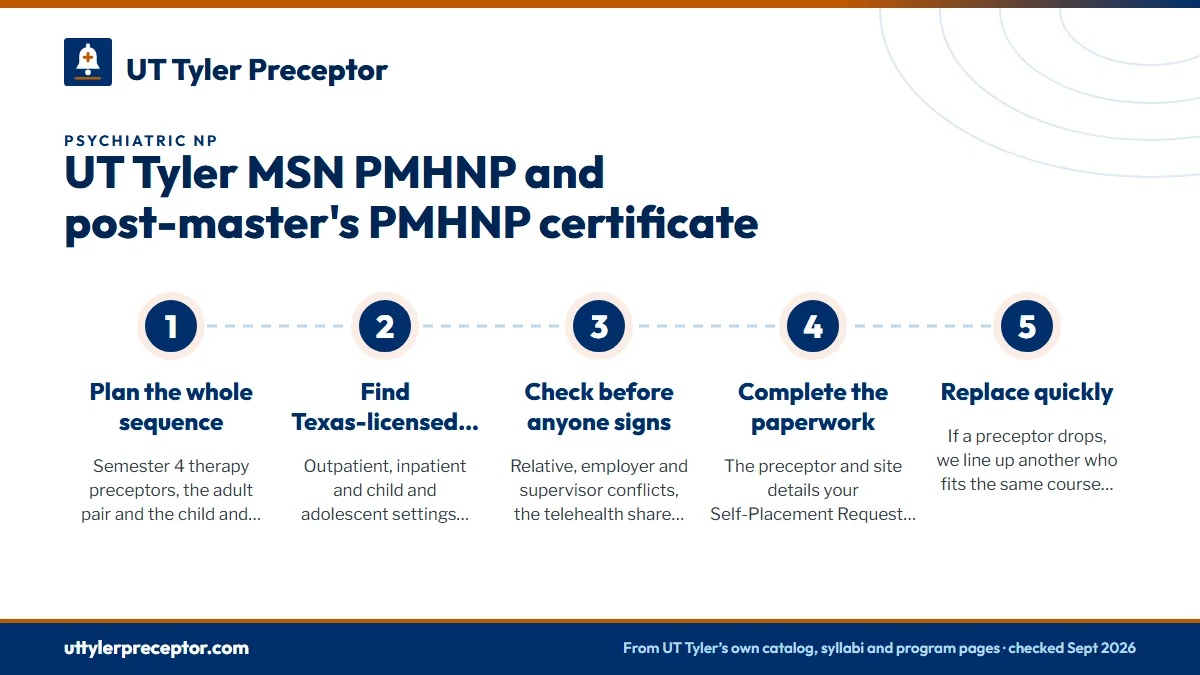
- Plan the whole sequenceSemester 4 therapy preceptors, the adult pair and the child and adolescent pair, with the two-rotation limit built in from the start.
- Find Texas-licensed sites near youOutpatient, inpatient and child and adolescent settings, with a PMHNP as the main preceptor wherever possible.
- Check before anyone signsRelative, employer and supervisor conflicts, the telehealth share and the 80% population fit for each course.
- Complete the paperworkThe preceptor and site details your Self-Placement Request asks for, plus what the facility agreement needs, early enough for Exxat and faculty approvals.
- Replace quicklyIf a preceptor drops, we line up another who fits the same course and rules.
Start on the placement request form with your county and the semester your practicums begin.
Questions UT Tyler students ask
Can PMHNP clinical hours be done by telehealth at UT Tyler?
Partly. Each PMHNP clinical course allows up to 63 telehealth hours, and the preceptor, student and patients must all be in Texas. UT Tyler's NP preceptor guide adds that telehealth teaching must be performed onsite with the preceptor supervising. The rest of each course is in-person care, and at least 125 program hours must be inpatient.
Can a psychiatrist precept a UT Tyler PMHNP student?
Yes. Primary preceptors can be PMHNPs, psychiatrists (MD or DO) or physician assistants with a CAQ in psychiatry, all licensed in Texas. The syllabi add that most of your clinical experience should be under PMHNP preceptors, so a psychiatrist fits well for one rotation while PMHNPs carry the majority across the program.
Can I keep the same preceptor for all my PMHNP practicums?
No. UT Tyler caps each preceptor at two rotations over the full program, so across the adult pair and the child and adolescent pair you need at least two preceptors. The second one matters most for NURS 5370, which needs a caseload with enough children and teenagers to meet its pediatric minimums.
Does UT Tyler place PMHNP students in clinical sites?
Graduate students at UT Tyler choose their clinical sites with their instructor's approval, and the PMHNP syllabi tell students facing placement or preceptor problems to notify their lead faculty promptly. Your faculty coordinate and sign off, and the Clinical Coordinator checks each site. We do the finding: a Texas-licensed preceptor and site that fit your course, with the request details ready.
Should I choose the two-year or three-year PMHNP format?
UT Tyler lets you pick either. In the catalog's part-time outline, the paired practicums fall in semesters 5 and 6, and each pair puts 250 clinical hours into one semester. Whichever format you choose, confirm with your advisor which semester opens NURS 5367, because that date sets when your first psychiatric preceptor must be approved.
Related pages
Last checked 2026-09-25
We check these pages against UT Tyler's own catalog, syllabi, program pages and clinical policies, and Texas rules. Your course, your program coordinator and the Clinical Coordinator have the final word.
UT Tyler asks you to choose your clinical site. We find it.
Tell us your UT Tyler track, where in Texas you live and when your next clinical course starts. We find preceptors near you who fit the course and gather everything your Self-Placement Request needs, so faculty can approve it before the semester.
- Preceptors matched to the course: pediatrics for
NURS 5453, adult and geriatric care forNURS 5455, psychiatric care forNURS 5367 - Texas-licensed preceptors who clear UT Tyler's supervisor, relative and site rules
- Anywhere in Texas, from the Piney Woods to the Valley
Start your placement plan
Program, city and start date is all we need to begin.