UT Tyler's BSN to DNP: five concentrations and every placement they need
UT Tyler's BSN to DNP takes a nurse with a bachelor's degree to a doctorate through one of five concentrations: FNP, PMHNP, Informatics, Quality and Safety (IQS), Administration or Education. The two nurse practitioner paths carry 1,250 hours and follow UT Tyler's Texas-only clinical rule; the other three carry 1,000. Along the way you propose specialty preceptors and then a DNP practice site, and our placement desk plans each one with you from the first semester.
Plan every BSN to DNP placement
Tell us your concentration, your start term and where you live. A placement advisor maps which semesters need a preceptor or a site.
The five concentrations side by side
UT Tyler's online-program page lists five concentrations, each pairing specialty courses with the same 39-credit DNP core. Courses are year-round and asynchronous, and the page mentions brief on-site intensives only where advanced clinical skills require them.
| Concentration | Credits | Hours | What you will line up |
|---|---|---|---|
| FNP | 71 (32 specialty, 39 DNP core) | 1,250 | Texas preceptors for NURS 5453, NURS 5454, NURS 5455, NURS 5347 and NURS 5349, then a DNP practice site |
| PMHNP | 73 (34 specialty, 39 DNP core) | 1,250 | Texas psychiatric preceptors for NURS 5367, NURS 5368, NURS 5370 and NURS 5373, then a DNP practice site |
| IQS | 57 (18 specialty, 39 DNP core) | 1,000 | An optional preceptor for the NURS 5390 practicum, then a DNP practice site |
| Administration | 51 (12 specialty, 39 DNP core) | 1,000 | Nurse leader preceptors for the specialty courses, then a DNP practice site |
| Education | 54 (15 specialty, 39 DNP core) | 1,000 | A nurse faculty mentor in a pre-licensure RN program for NURS 5329, then a DNP practice site |
The page gives each total without dividing it between specialty clinicals and DNP practice hours. For the Administration path it adds that 24 clinical hours are embedded in each specialty course.
What the catalog shows, and where it disagrees
The 2026-27 catalog does not match the online page line for line. Its doctoral section carries three pathway pages, for Administration, Education and PMHNP, while the online page offers five concentrations. The catalog page titled Education actually prints the FNP plan: 71 credits over 11 part-time semesters.
The part-time outlines that do appear give a sense of pace. The PMHNP path runs 12 semesters, with its paired psychiatric practicums in semesters 5 and 6. The Administration path runs 8. In the FNP outline, NURS 5453 arrives in the third semester of the specialty sequence and NURS 5349 closes it in the last.
With three sources telling slightly different stories, the plan that counts is the degree plan you sign with your advisor during your first semester. Bring the online page and the catalog outline to that meeting and ask which term each clinical course lands in, because that date sets the start of every preceptor search that follows.
The NP paths: Texas residence and a Texas license
The FNP and PMHNP concentrations lead to an APRN license, so UT Tyler's graduate clinical rule applies: you must be a Texas resident, and every clinical hour happens at a Texas site. The BSN to DNP catalog pages add that APRN-seeking candidates must hold a Registered Nurse license in the state of Texas. The PMHNP pathway page still carries older wording about a license in the state or states where clinical practicum will occur; the Texas rule on the graduate page and in the catalog is the one to follow, and Texas-only clinicals covers it in full.
Inside the specialty courses, the NP paths follow the same clinical rules as UT Tyler's MSN tracks: the FNP's primary care courses and internships with their OSCE days on campus, and the PMHNP's telehealth cap, inpatient minimum and limits on reusing a preceptor. The MSN FNP and MSN PMHNP guides go course by course. The preceptor search is the same whether your degree ends in an MSN or a DNP.
The PMHNP path also includes NURS 5363 and NURS 5365, which the catalog counts as clinical courses without printing their hours. Your syllabus and course faculty set those.
The non-APRN paths: Administration, Education and IQS
Non-APRN candidates may be licensed wherever their practicum takes place, so these three concentrations can suit nurses outside Texas, subject to UT Tyler's state authorization rules. Each one has its own preceptor profile.
- Administration: a nurse leader with a BSN and a graduate degree (MSN, MBA or MHA) who plays no part in your work evaluations. UT Tyler's Administration preceptor guide sets those rules, and each specialty course embeds 24 placement hours.
- Education: an academic practicum in a pre-licensure RN program, mentored by nurse faculty with at least an MSN, and a hospital staff development experience if you want one.
- IQS: the 130-hour
NURS 5390practicum, where working with a preceptor is one option among several hands-on routes.
In each case the pattern matches the rest of UT Tyler's graduate programs: you propose the preceptor and site, course faculty approve, and the School of Nursing clears the facility before any hours count.
The DNP core and its practice site
All five paths finish with the 39-credit DNP core that post-master's students also take, with its DNP Project and the pairing of a UT Tyler faculty mentor with an outside industry mentor. The practice site is yours to choose, and no hours count there until UT Tyler has a fully executed affiliation agreement with it, even when the site is your employer.
Because the DNP core follows years of specialty work, BSN to DNP students hold an advantage that post-master's students often lack: time to plan. A practice where you did NP clinicals, or a leader you met during an administration practicum, can become your DNP site if the relationship is built early. The post-master's DNP guide covers the core course by course, and DNP practice hours explains logging those hours in Exxat.
How our placement desk plans a BSN to DNP
A BSN to DNP can run a dozen part-time semesters, and every clinical course needs its approvals before that semester starts. We plan the whole sequence instead of one course at a time.
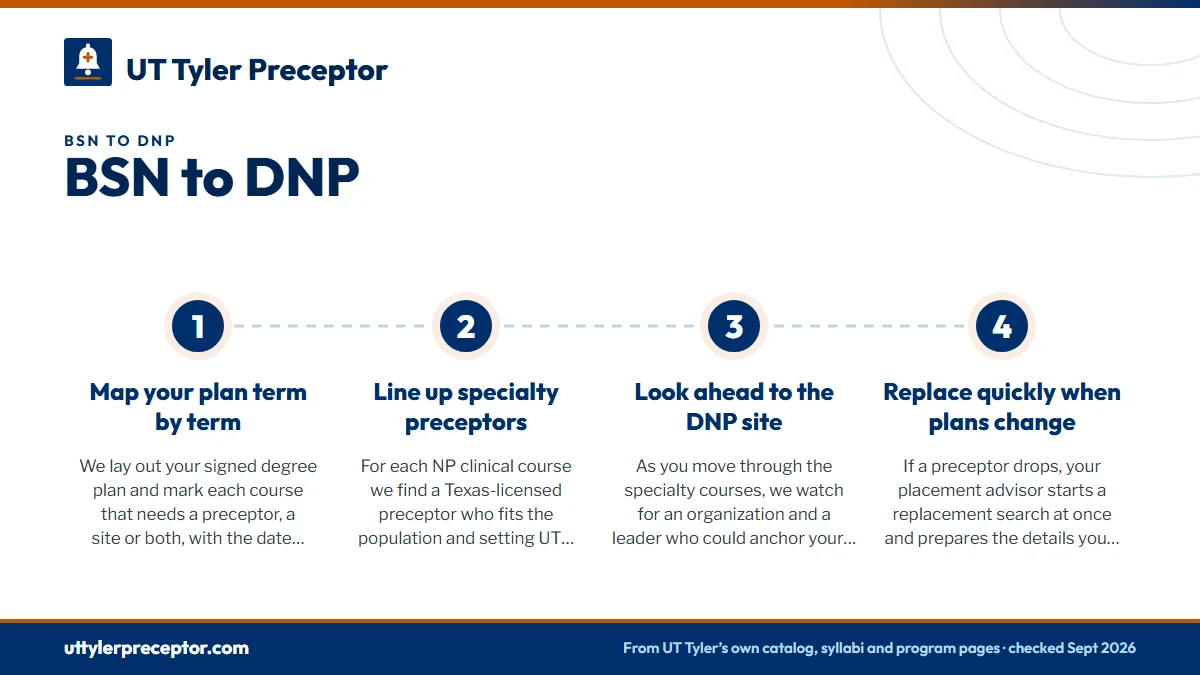
- Map your plan term by termWe lay out your signed degree plan and mark each course that needs a preceptor, a site or both, with the date approvals are due.
- Line up specialty preceptorsFor each NP clinical course we find a Texas-licensed preceptor who fits the population and setting UT Tyler asks for, outside your chain of command and family, and we gather what the Self-Placement Request needs.
- Look ahead to the DNP siteAs you move through the specialty courses, we watch for an organization and a leader who could anchor your DNP Project, so the affiliation agreement can start early.
- Replace quickly when plans changeIf a preceptor drops, your placement advisor starts a replacement search at once and prepares the details you send your faculty.
Reach a placement advisor through the form below.
Questions UT Tyler students ask
Can I do UT Tyler's BSN to DNP from outside Texas?
It depends on the concentration. The FNP and PMHNP paths call for Texas residence and Texas clinical sites for every hour. The Administration, Education and IQS paths are online and accept students elsewhere with conditions, including an RN license where your practicum happens. UT Tyler's licensure chart also lists the Doctor of Nursing Practice as not meeting requirements in Georgia.
Is a compact RN license enough for the BSN to DNP nurse practitioner paths?
UT Tyler's sources differ. UT Tyler's graduate clinical requirements allow either a compact license or a Texas license for APRN clinical hours. The current catalog is stricter and names a Texas RN license for candidates headed toward APRN licensure. Holding a Texas license settles the question either way; RN license requirements tracks the wording program by program.
When does the first clinical course start in the BSN to DNP?
It depends on the path. In the catalog's FNP outline, the first primary care course, NURS 5453, comes in the third semester, after advanced pathophysiology, health assessment, pharmacology and diagnostic methods. The PMHNP outline places its paired practicums in semesters 5 and 6. Start the preceptor search for that first course at least one semester before it begins.
Does the BSN to DNP FNP path include campus days?
Yes, through its FNP clinical courses, which hold on-campus OSCEs, usually around Week 11. UT Tyler describes those as the only mandatory campus dates in the courses. The DNP core can add on-campus intensives and your DNP Project presentation, so budget for a few trips to Tyler across the program and keep clinical days clear around them.
Who approves my BSN to DNP preceptors?
Your course faculty. For each clinical course you propose a preceptor and site, the preceptor completes UT Tyler's online Preceptor Agreement, faculty approve, and the Clinical Coordinator verifies the details and confirms the facility agreement before hours count. Approvals come before each clinical semester, so plan for them every term, not only the first.
Related pages
Last checked 2026-09-25
We check these pages against UT Tyler's own catalog, syllabi, program pages and clinical policies, and Texas rules. Your course, your program coordinator and the Clinical Coordinator have the final word.
UT Tyler asks you to choose your clinical site. We find it.
Tell us your UT Tyler track, where in Texas you live and when your next clinical course starts. We find preceptors near you who fit the course and gather everything your Self-Placement Request needs, so faculty can approve it before the semester.
- Preceptors matched to the course: pediatrics for
NURS 5453, adult and geriatric care forNURS 5455, psychiatric care forNURS 5367 - Texas-licensed preceptors who clear UT Tyler's supervisor, relative and site rules
- Anywhere in Texas, from the Piney Woods to the Valley
Start your placement plan
Program, city and start date is all we need to begin.