Texas NP practice: prescriptive authority agreements and what they mean for your preceptor
Texas does not give nurse practitioners full practice authority. An NP's diagnosing and prescribing rest on authority a physician delegates, and prescribing is set out in a prescriptive authority agreement that fixes rules on meetings, chart review and how many NPs one physician can cover. The NPs who precept you in Texas practice under these arrangements, and once licensed you will too.
Find a Texas NP preceptor who fits your course
Name your UT Tyler track and city, and your placement advisor checks each NP's license and practice before you file.
Texas is a restricted practice state
AANP classifies Texas as restricted, meaning physician delegation and supervision are required for NP practice. The Texas Board of Nursing says so directly: Texas APRNs lack full practice authority, and an APRN's scope may include medical diagnosis and prescriptive authority when a physician properly delegates them.
For a UT Tyler student this is background you will meet in every clinic. Your NP preceptor's prescriptions sit inside a delegation arrangement with a physician, and part of what you absorb in clinical is how that arrangement shapes the working day: which decisions the NP makes alone, which ones go to the physician, and how the two stay in touch.
Licensure and prescribing are separate steps. The Board licenses Texas APRNs with prescriptive authority as an option, and once you hold your own license, prescribing depends on an agreement of your own with a delegating physician.
What a prescriptive authority agreement requires
Texas Occupations Code §157.0512 lets a physician delegate the prescribing and ordering of drugs and devices to an APRN or physician assistant through a prescriptive authority agreement. The statute and the Board's APRN practice FAQ set these terms.
| Term | What the law says |
|---|---|
| Delegation | A physician may delegate prescribing or ordering a drug or device to an APRN or PA acting under adequate physician supervision |
| Ratio | Up to seven APRNs and PAs, or their full-time equivalent, per delegating physician |
| Exemptions from the ratio | Practices serving medically underserved populations and hospital facility-based practices |
| Required content | A general plan for consultation and referral, and a quality plan with chart review and periodic meetings |
| Meetings | At least once a month; no longer required to be face to face since House Bill 278 (2019) |
| Review | The agreement is reviewed at least once a year |
The Board's FAQ states the ratio as one physician delegating to no more than seven full-time-equivalent APRNs and PAs, written 1:7.
What it means for your preceptor
A Texas NP who diagnoses and prescribes does so under a physician's delegation, but that physician may not be on site. Monthly meetings no longer have to be face to face, so an NP can see patients with the physician reachable rather than present. What matters to UT Tyler is the NP's own license and practice: faculty approve the NP as your preceptor, and the NP supervises and evaluates your work.
The physician can still matter to your placement. UT Tyler's FNP syllabi recommend a quarter of program hours with an APRN and allow the rest with a physician (MD or DO) or PA, so a practice where an NP and a physician both see patients on site can cover more of your hours. PMHNP syllabi accept psychiatrists as primary preceptors but expect most hours with PMHNPs.
Board rules shape the check. A qualified preceptor holds an active, unencumbered license and is in current practice in the advanced role and population focus, so the preceptor's actual patient panel has to match the population your course covers. Preceptor requirements lists UT Tyler's rules by track, and Texas Board of Nursing rules covers the education rules.
Learning the agreement while you train
Clinical time is the easiest place to see how a prescriptive authority agreement works before you need one. With your preceptor's permission, ask how the practice handles the three things the statute puts in writing: when and how the NP consults or refers to the physician, how chart review is done, and how the monthly meeting runs.
Those answers pay off twice. They show you how prescribing decisions move through a Texas practice, which helps when you present patients and propose plans to your preceptor. And they give you a working model for the first agreement you negotiate after licensure, when the terms will be yours to settle.
Keep what you hear general in your clinical logs and assignments. The specific terms of a practice's agreement belong to the practice, and your preceptor will be more open with you if you treat them that way.
Becoming a licensed NP in Texas
The Board's licensure page lists what a Texas APRN license with optional prescriptive authority requires:
- A Texas RN license or an RN license with compact privilege
- Completion of a program that meets Board Rule 221.3, which includes 500 separate clinical hours in your role and population
- A national certification matching the role and population your program prepared you for
- 400 practice hours in the past 24 months, or completion of your program within 24 months
- 20 contact hours of continuing education in 24 months, or completion of your program within 24 months
Texas has been part of the Nurse Licensure Compact since January 19, 2018, and UT Tyler's graduate page lets APRN students do clinical hours on either a Texas or a multistate license. For certification, UT Tyler names AANPCB for FNP graduates and the ANCC PMHNP-BC exam for PMHNP graduates; NP certification exams has the details.
Where Texas NPs practice
Your pool of possible preceptors follows where Texas NPs work. The Texas Department of State Health Services counted 30,498 actively licensed NPs working in Texas in 2023. Family health was the most common specialty, about one in four, and 85.5 percent practiced in metropolitan counties away from the border, against 7.4 percent in nonmetropolitan counties away from the border and 0.5 percent in nonmetropolitan border counties.
Shortage designations point the other way. HRSA's data as of June 30, 2026, show 451 primary care and 412 mental health shortage-area designations in Texas, with under a third of the state's mental health need met. For a student in a rural county, the nearest NP preceptor who fits the course can be a long drive away, and UT Tyler's rule that every APRN clinical hour happens in Texas keeps the search inside the state. See East Texas for UT Tyler's home region.
How we match you with Texas NP preceptors
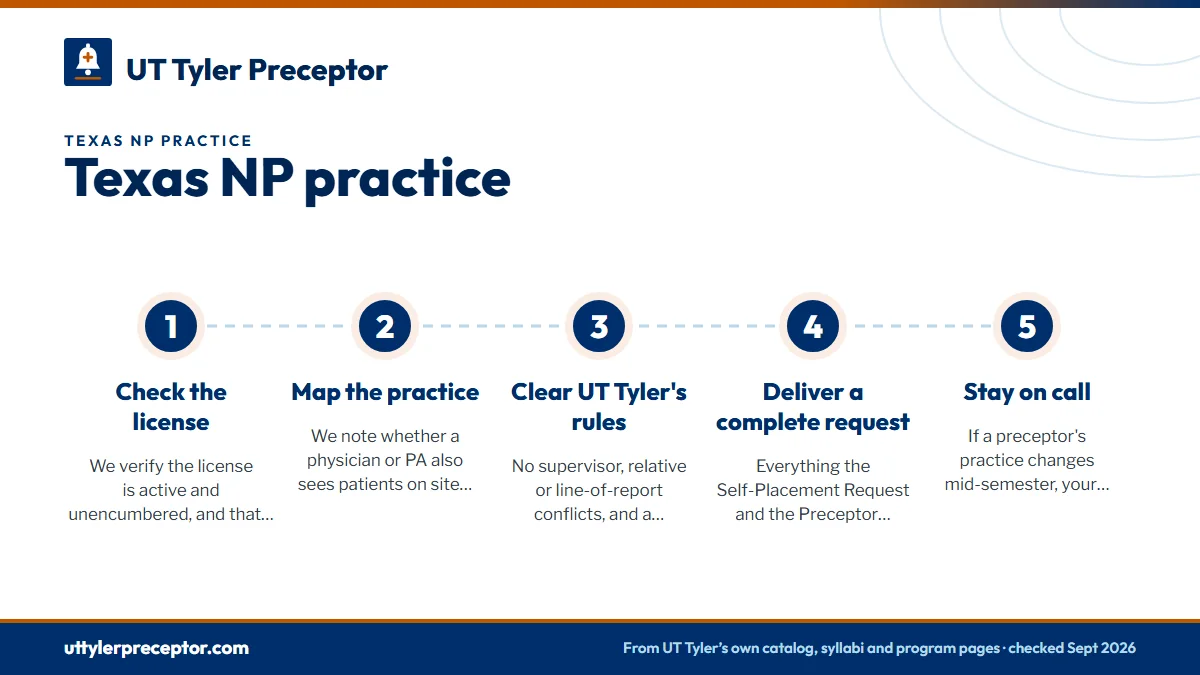
- Check the licenseWe verify the license is active and unencumbered, and that the preceptor's patients today match your UT Tyler course.
- Map the practiceWe note whether a physician or PA also sees patients on site, useful for FNP hours beyond the APRN share or for PMHNP psychiatrist hours.
- Clear UT Tyler's rulesNo supervisor, relative or line-of-report conflicts, and a facility ready to sign the affiliation agreement.
- Deliver a complete requestEverything the Self-Placement Request and the Preceptor Agreement ask for, ready for faculty approval before the semester.
- Stay on callIf a preceptor's practice changes mid-semester, your placement advisor finds a replacement who meets the same checks.
Start with the placement form and your placement advisor begins the search in your part of Texas.
Questions UT Tyler students ask
Does my NP preceptor need a physician on site while I am in clinical?
The delegation rules summarized here do not require it. Monthly meetings between the NP and the delegating physician no longer need to be face to face, and the agreement relies on a written plan for consultation and referral. UT Tyler approves the NP as your preceptor, so the physician's presence matters only if you need physician hours or a facility policy requires it.
Can I use a compact RN license for UT Tyler NP clinicals?
Yes, according to UT Tyler's graduate page, which allows APRN clinical hours on an unencumbered multistate license as well as a Texas one. Texas joined the compact in 2018. The 2026-27 catalog, however, asks APRN-seeking applicants for a Texas RN license, so the two sources differ. RN license requirements tracks that conflict.
When does a new UT Tyler graduate need a prescriptive authority agreement?
Only when you are ready to prescribe, not to earn the APRN license itself. Texas licenses APRNs with prescriptive authority as an option, and prescribing rests on physician delegation through an agreement that meets the statute's terms on consultation, chart review, monthly meetings and annual review. Watching your preceptors' arrangements during clinicals is a practical preview.
Does the seven-NP limit affect hospital-based NP preceptors?
Not in the same way. The statute exempts hospital facility-based practices and practices serving medically underserved populations from the seven full-time-equivalent cap. For your placement, the rules that matter are the preceptor's license, population focus and UT Tyler's approval, whatever delegation model the practice uses.
Related pages
Last checked 2026-09-25
We check these pages against UT Tyler's own catalog, syllabi, program pages and clinical policies, and Texas rules. Your course, your program coordinator and the Clinical Coordinator have the final word.
UT Tyler asks you to choose your clinical site. We find it.
Tell us your UT Tyler track, where in Texas you live and when your next clinical course starts. We find preceptors near you who fit the course and gather everything your Self-Placement Request needs, so faculty can approve it before the semester.
- Preceptors matched to the course: pediatrics for
NURS 5453, adult and geriatric care forNURS 5455, psychiatric care forNURS 5367 - Texas-licensed preceptors who clear UT Tyler's supervisor, relative and site rules
- Anywhere in Texas, from the Piney Woods to the Valley
Start your placement plan
Program, city and start date is all we need to begin.