UT Tyler AGACNP practica: six 125-hour acute care rotations, one per 7-week session
UT Tyler's post-master's AGACNP certificate puts its 750 clinical hours into six practica, NURS 7383 through NURS 7388, each 125 hours long and each fitted into one 7-week Flex session. At that pace there is no slack: the syllabi expect a schedule by Friday of Week 2 and a secured placement by the end of Week 2. Acute care preceptors and hospital clearances need to be ready before each session opens.
Line up your AGACNP practica
Tell us your cohort year and city, and your placement advisor plans acute care preceptors for every Flex session.
Six practica over three semesters
The certificate is 30 credits over two years, doctoral level, with a fall start only (applications close August 9) and courses taken in sequence. The first year's fall and spring hold Principles of Acute Care 1 to 4 (NURS 7351 to NURS 7354), which carry no clinical hours. The practica follow, two per semester, one in each Flex session.
| Course | Title | Hours | Program term | Session |
|---|---|---|---|---|
NURS 7383 | Practicum I for the AGACNP | 125 | Year 1, summer | Flex I |
NURS 7384 | Practicum II | 125 | Year 1, summer | Flex II |
NURS 7385 | Practicum III | 125 | Year 2, fall | Flex I |
NURS 7386 | Practicum IV | 125 | Year 2, fall | Flex II |
NURS 7387 | Practicum V | 125 | Year 2, spring | Flex I |
NURS 7388 | Practicum VI | 125 | Year 2, spring | Flex II |
In the 2026-27 School of Nursing calendar, the Flex sessions run Aug 27 to Oct 17 and Oct 19 to Dec 12 in fall, Jan 7 to Feb 27 and Mar 1 to Apr 24 in spring, and May 10 to Jun 26 and Jun 28 to Aug 14 in summer. One catalog wrinkle: the 2026-27 catalog names the certificate, but its certificate page was not available when we checked in September 2026, so the 2025-26 catalog is the last full listing, and older AGACNP course numbers still appear in the course list.
What 125 hours in seven weeks looks like
The NURS 7385 syllabus recommends setting aside 20 hours a week of clinical time for every 3-credit clinical course. By our arithmetic, 125 hours over seven weeks is just under 18 a week, so the recommendation builds in roughly one spare clinical day across the session. For a working nurse, that usually means two long clinical days every week for seven weeks straight.
The sessions also sit back to back. In fall 2026, Flex I ends Saturday, October 17, and Flex II opens Monday, October 19, with only a Sunday between them. The preceptor for your second practicum has to be approved while you are still finishing the first, and there is no break in which to run a search.
The NURS 7386 syllabus lets you move as many as three clinical days per term at your own request. Treat those three days as your whole margin, and choose a preceptor whose schedule can carry the pace from the first week.
Week 2: the deadline that shapes every session
The Fall 2026 AGACNP syllabi set two early markers. At least a partial tentative schedule is due by Friday of Week 2. And a placement not secured by the end of Week 2, the syllabus warns, may seriously affect your ability to finish the course by the end of the semester. If a preceptor is hard to find, you tell both faculty and the Clinical Coordinator immediately.
Now add processing time. The same syllabus asks you to allow 48 to 72 business hours for faculty and staff to review documents, compliance, schedules and preceptor approvals. A preceptor found in Week 2 may not be cleared until Week 3, with more than a quarter of the session already gone.
Taken at its word, policy 7.2 puts approval of all sites and preceptors ahead of the semester's first day, which would cover the Flex II practicum as well. Ask your AGACNP program coordinator how that applies to your second session, and plan both practica in a semester as a single search.
Waiting for the session to open before searching is the costly mistake. With a Week 2 deadline and a 48 to 72 business hour review, the preceptor for each practicum has to be found, and ideally approved, before Week 1.
Good to Go for every site and preceptor
Before you start, you upload a clinical schedule plus every applicable "Good to Go" email from the Clinical Coordinator, one for each approved site and preceptor on that schedule. That email ends a chain of steps: your Self-Placement Request, the preceptor's online Preceptor Agreement, faculty approval, then the Clinical Coordinator's checks, the facility's affiliation agreement and its own onboarding.
Each name on your schedule needs its own clearance. A plan that spreads one practicum across three hospitalists at two hospitals multiplies the paperwork and the chances of a delay, while one or two committed preceptors at a single site clear with fewer moving parts. Complete preceptor details, sent early, are the quickest route to each clearance. Preceptor approval explains each step, and compliance requirements covers what your Exxat record must show.
Hospitals set their own clocks
Acute care means hospitals, and hospitals run student requests on their own timelines. CHRISTUS Trinity Mother Frances in Tyler, according to its student page, expects students to verify that their school holds an active affiliation agreement with CHRISTUS, to arrive with a preceptor already, and to apply by March 1, July 1 or November 1 for rotations starting after April 1, August 1 or December 1, reapplying each semester. In Longview, CHRISTUS Good Shepherd sets a 60-day lead time for preceptor applications, according to its page.
Map that onto your sequence. A summer Flex I practicum starting May 10 falls in the window that follows the March 1 request date, so the search for your first practicum belongs in the spring of your first year, while you are still in Principles of Acute Care.
Location and population rules sit on top. UT Tyler's graduate page makes Texas residence and Texas-only clinical hours a condition for APRN students, while the AGACNP program page still ties the RN license to wherever the practicum happens; Texas-only clinicals sorts that out. The program page also describes adults and adolescents, while the course text speaks of adult and geriatric patients, so ask faculty whether adolescent encounters count.
How we line up six practica
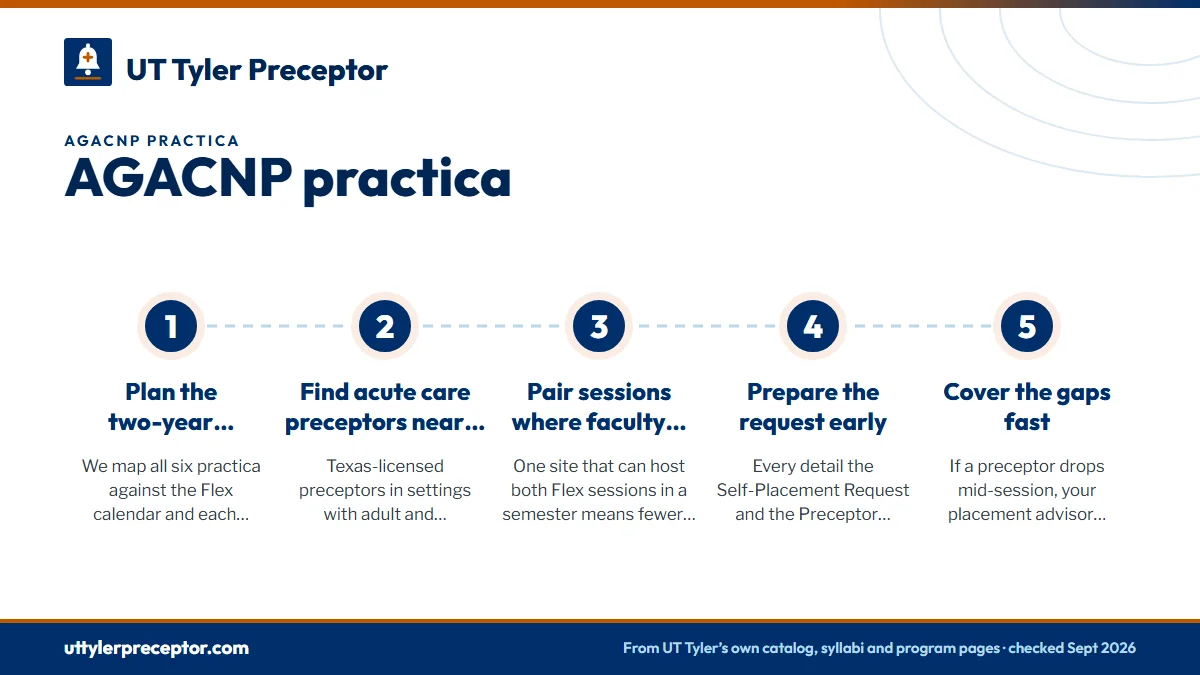
- Plan the two-year sequenceWe map all six practica against the Flex calendar and each hospital's request windows, so the first search starts months before the first session.
- Find acute care preceptors near youTexas-licensed preceptors in settings with adult and geriatric acute patients, able to give you about 20 hours a week for seven weeks.
- Pair sessions where faculty allow itOne site that can host both Flex sessions in a semester means fewer new clearances at the handoff between them.
- Prepare the request earlyEvery detail the Self-Placement Request and the Preceptor Agreement need, ready before the semester so Good to Go emails can arrive on time.
- Cover the gaps fastIf a preceptor drops mid-session, your placement advisor brings a replacement quickly, because a lost week is a seventh of the course.
Tell us your cohort year and city on the placement form. For the full certificate picture, see the AGACNP certificate page and the academic calendar.
Questions UT Tyler students ask
When do UT Tyler AGACNP students start clinical hours?
In the first summer. The certificate starts only in fall, and the first year's fall and spring hold the four Principles of Acute Care courses with no clinical hours. NURS 7383 opens the practica in summer Flex I; in the 2026-27 calendar that session begins May 10, 2027, for students who started in fall 2026.
Can I do my AGACNP practicum hours at the hospital where I work?
Ask your course faculty before you file. UT Tyler's published AGACNP material does not spell out a workplace rule, while the FNP and PMHNP syllabi bar supervisors, relatives and, for FNP students, anyone in their line of report. Whatever faculty decide, the Clinical Coordinator still needs an affiliation agreement with your hospital and a Good to Go email before any hour counts.
Can one preceptor cover more than one AGACNP practicum?
UT Tyler's published AGACNP material sets no reuse limit like the PMHNP program's two-rotation rule, so the answer rests with your faculty. If they allow it, keeping an approved preceptor from Flex I into Flex II means one fewer new approval to chase in the gap between sessions. Ask before you build a whole semester around one person.
What if my AGACNP preceptor cancels in the middle of a session?
Notify your faculty and the Clinical Coordinator immediately, as the syllabi require for placement problems. Remember the 48 to 72 business hours needed to process a new preceptor, and use your three student-initiated reschedule days carefully while a replacement is approved. Your placement advisor starts looking for that replacement as soon as you tell us.
Is the AGACNP certificate the same as the nurse anesthesia program's acute care track?
No. The DNP-Nurse Anesthesia program embeds AGACNP preparation in a 36-month in-person degree, with its own acute care practica, NURS 7391 and NURS 7392 at 375 hours each in the catalog, and program hospitals across East Texas. The certificate described here uses NURS 7383 to NURS 7388 and preceptors you propose. See the nurse anesthesia page.
Related pages
Last checked 2026-09-25
We check these pages against UT Tyler's own catalog, syllabi, program pages and clinical policies, and Texas rules. Your course, your program coordinator and the Clinical Coordinator have the final word.
UT Tyler asks you to choose your clinical site. We find it.
Tell us your UT Tyler track, where in Texas you live and when your next clinical course starts. We find preceptors near you who fit the course and gather everything your Self-Placement Request needs, so faculty can approve it before the semester.
- Preceptors matched to the course: pediatrics for
NURS 5453, adult and geriatric care forNURS 5455, psychiatric care forNURS 5367 - Texas-licensed preceptors who clear UT Tyler's supervisor, relative and site rules
- Anywhere in Texas, from the Piney Woods to the Valley
Start your placement plan
Program, city and start date is all we need to begin.