Who does what in a UT Tyler clinical course, and who to ask
A UT Tyler clinical course involves more people than the syllabus lists: course faculty who approve, a Clinical Coordinator who clears, program coordinators who lead each track, your preceptor, the facility and you. Sending a question to the right role saves days. UT Tyler's documents use several titles for the same kinds of work, so this page maps each role by what it does.
Get your placement plan
Tell us your UT Tyler program and where you live. A placement advisor replies with preceptor and site options in your community that fit your UT Tyler course.
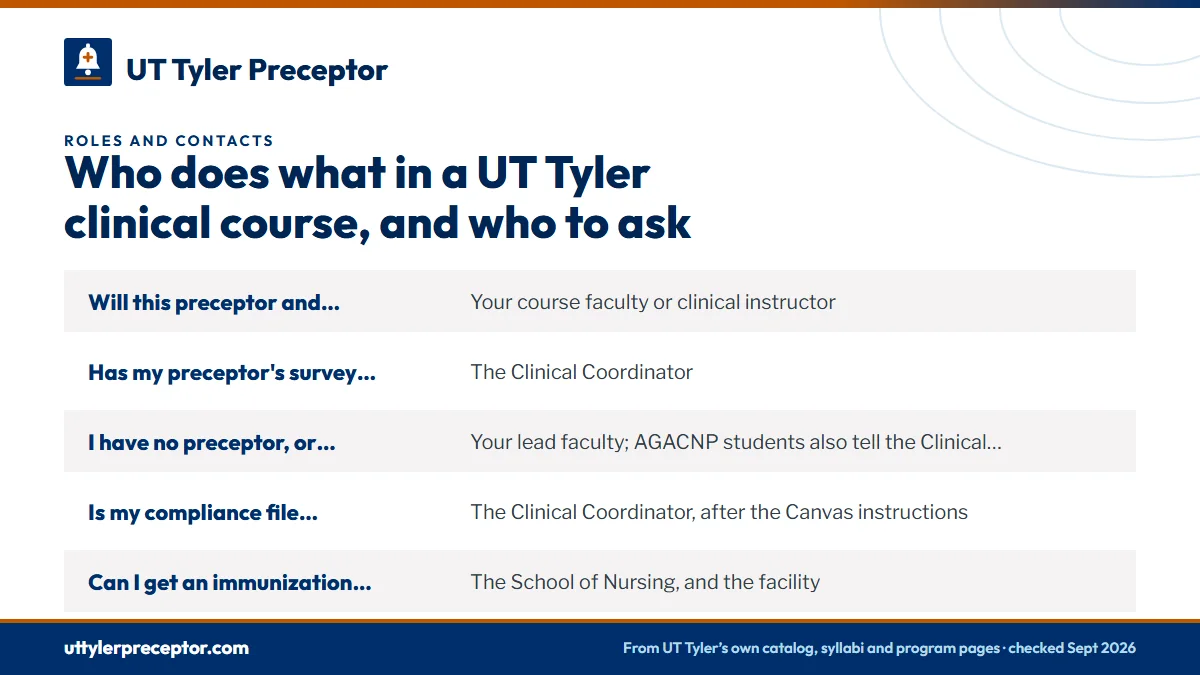
Who to ask, question by question
Start here when something comes up mid-semester. The right-hand column gives the reason, drawn from UT Tyler's policies, guides and syllabi.
| Your question | Ask | Why that role |
|---|---|---|
| Will this preceptor and site work for my course? | Your course faculty or clinical instructor | Faculty approve every site and preceptor |
| Has my preceptor's survey come back? Is the facility contract signed? | The Clinical Coordinator | Verifies preceptors, sends the agreement survey, handles facility contracts and onboarding |
| I have no preceptor, or mine cancelled | Your lead faculty; AGACNP students also tell the Clinical Coordinator | PMHNP and AGACNP syllabi ask for prompt notice |
| Is my compliance file complete? | The Clinical Coordinator, after the Canvas instructions | Clinical staff confirm clearance before you start |
| Can I get an immunization exemption? | The School of Nursing, and the facility | The school decides exemptions, not the compliance vendor, and each facility sets its own exclusions |
| My RN license has a restriction | The appropriate program director | Policy 2.4.4 tells you to contact them |
| Degree plan, course equivalency or transfer credit | The Graduate Nursing Advisor; transfer credit goes to the Assistant Dean, Graduate Programs | Policy 5.2 and the MSN catalog |
| A question about the whole track, not one course | Your program coordinator or director | Each graduate track has one on the leadership page |
| Accommodations for a clinical course | Student Accessibility and Resources | The Student Guide asks for requests 30 days before classes |
Course faculty: approval, oversight and grades
Your course faculty, called clinical instructor or lead faculty in some syllabi, hold the approval that matters most. UT Tyler's NP guide has them coordinate with you on sites and preceptors and approve both, and Fall 2026 FNP syllabi repeat that the clinical instructor approves each site and preceptor.
Faculty stay involved after you start. FNP syllabi describe an online check-in among faculty, you and your preceptor, possible unannounced site visits and clinical spot checks, and faculty grade the course, including the two passing Clinical Performance Evaluations FNP students need from preceptors.
Faculty are also the first call when a placement goes wrong, though each track words it differently. PMHNP students notify lead faculty promptly, AGACNP students tell both faculty and the Clinical Coordinator at once, and FNP students alert faculty if a site cannot give the direct experience a course requires. What to do that week is on can't find a preceptor.
The Clinical Coordinator, under several titles
The role that clears your placement goes by different names depending on the document. Policy 7.2 and the AGACNP syllabi say Clinical Coordinator. The Administration syllabi and a compliance policy say Clinical Liaison, a DNP syllabus says clinical placement coordinator, and another policy says clinical experience liaison. All of them describe the School of Nursing's link between you, the facility and the paperwork.
Across UT Tyler's documents, that work covers verifying your preceptor's details, emailing the Preceptor Agreement survey, working the facility contract and onboarding, and sending clearance, whether that is a Good to Go message for an AGACNP site or the Clinical Requirements Complete notice in Administration courses. The sign-offs are detailed on Preceptor Agreement and approval.
One gap to know about: UT Tyler's School of Nursing staff page lists an Undergraduate Clinical Coordinator and an Onboarding & Student Success Coordinator, but no graduate clinical role. Your syllabus and Canvas course name the contact for your course and semester.
Program coordinators, directors and advisors
Each graduate track has a leader on the School of Nursing's leadership page: an MSN FNP Coordinator, a PMHNP Program Coordinator, an AGACNP Program Coordinator, a DNP Program Director, and coordinators for Administration, Education, Informatics and RN-MSN. The Assistant Dean, Graduate Programs sits above them, and BSN students have site coordinators in Tyler, Palestine and Longview.
Take questions about your whole program, rather than a single course, to your program coordinator. UT Tyler's policies send licensed nurses with a license restriction to the appropriate program director, and the MSN catalog places transfer credit approval with the Assistant Dean. The Graduate Nursing Advisor handles course equivalency reviews, and your first graduate semester should end with a degree plan signed by you and your advisor.
For time limits, Incompletes and what a clinical failure means, see grades and time limits.
Your preceptor and the facility
Your preceptor supervises and teaches you in the practice, confirms your hours on signature sheets where your course uses them, may review your logs if asked and completes your Clinical Performance Evaluations. The preceptor takes this on through UT Tyler's online agreement survey, while faculty remain responsible for the course. Who qualifies to precept each track is on preceptor requirements.
The facility is a separate party with its own rules. It signs the affiliation agreement with UT Tyler, sets its own onboarding requirements and deadlines, and decides its own immunization exclusions. When a hospital's student office asks you for something, it is asking on the facility's behalf, and UT Tyler may need to write you a Letter of Good Standing. See affiliation agreements.
The jobs that stay with you
UT Tyler's NP guide expects students to be self-directed in identifying their own learning needs, and several practical jobs follow from that.
- Finding and proposing the preceptor and site, then filing the Self-Placement Request with the preceptor's details
- Negotiating your clinical schedule with the preceptor, and revising and resubmitting it if the preceptor changes
- Giving each preceptor the UT Tyler Preceptor Handbook and reviewing it together
- Sharing at least three written, measurable objectives with the preceptor before the first shift (FNP)
- Logging hours on time in Exxat and keeping them matched to signature sheets
- Getting yourself to the site, which clinical policy makes the student's responsibility
- Evaluating your preceptor and facility at the end of the rotation
- Scheduling extra hours as a cushion, as the PMHNP syllabi recommend
Report a placement problem the week it happens, in writing, to the person your syllabus names. Late notice leaves faculty fewer options.
Where the placement desk fits
We work for you, on the item that takes the most time: finding the preceptor. Your placement advisor locates a Texas preceptor and site that suit your course, gathers what the Self-Placement Request needs, briefs the preceptor on UT Tyler's survey and evaluations, and stays with you through facility onboarding.
We also help you use the table at the top of this page: approval questions go to faculty, facility contract questions to the Clinical Coordinator, and we prepare what each of them needs to answer quickly.
Every approval stays where UT Tyler puts it, with your faculty and the Clinical Coordinator. What reaches them is complete and matched to the course, which is what makes a quick yes possible. If your preceptor drops, we start the replacement search that week. Read how it works or start on the placement request form.
Questions UT Tyler students ask
Who is the Clinical Coordinator for UT Tyler graduate nursing?
UT Tyler's policies and syllabi refer to a Clinical Coordinator, but the School of Nursing staff page lists only an Undergraduate Clinical Coordinator and an Onboarding & Student Success Coordinator. Your course syllabus and Canvas site name the right contact for your course and semester, and your course faculty can connect you.
Is my program coordinator the same as my course faculty?
They are separate roles in UT Tyler's structure. Course faculty teach one course and approve its clinical sites and preceptors. Program coordinators, such as the MSN FNP Coordinator or the PMHNP Program Coordinator, lead the whole track. Take site and preceptor questions to course faculty first and program-wide questions to the coordinator.
Who approves my clinical site at UT Tyler?
Your course faculty make the approval decision on site and preceptor. Before clearance, the Clinical Coordinator also has to be satisfied on compliance, the facility contract and onboarding. Policy 7.2 requires this before the semester begins. Pre-licensure BSN students are the exception, since faculty assign their placements.
Who evaluates me in a UT Tyler clinical course?
Preceptors complete Clinical Performance Evaluations, and FNP students need two passing ones at 80 percent. Faculty may meet with you and your preceptor online, visit the site and grade the course. You evaluate the preceptor and facility in turn, and UT Tyler policy places those evaluations with course faculty and the facility.
Who do I tell if my preceptor cancels?
Your lead or course faculty, right away; AGACNP students also tell the Clinical Coordinator. UT Tyler's NP guide then has you revise your clinical schedule and resubmit it. Any new preceptor goes through the survey and approval steps again before hours with them count.
Related pages
Last checked 2026-09-25
We check these pages against UT Tyler's own catalog, syllabi, program pages and clinical policies, and Texas rules. Your course, your program coordinator and the Clinical Coordinator have the final word.
UT Tyler asks you to choose your clinical site. We find it.
Tell us your UT Tyler track, where in Texas you live and when your next clinical course starts. We find preceptors near you who fit the course and gather everything your Self-Placement Request needs, so faculty can approve it before the semester.
- Preceptors matched to the course: pediatrics for
NURS 5453, adult and geriatric care forNURS 5455, psychiatric care forNURS 5367 - Texas-licensed preceptors who clear UT Tyler's supervisor, relative and site rules
- Anywhere in Texas, from the Piney Woods to the Valley
Start your placement plan
Program, city and start date is all we need to begin.