Grades, Incompletes and Time Limits in UT Tyler Nursing
In UT Tyler's MSN, every required course needs a B or better, a clinical course counts as passed only when both its classroom and clinical parts are passed, and two course failures end the program. Master's degrees must be finished within six years, and an Incomplete has to be resolved within one.
Protect your clinical grade
A preceptor lined up early, and a replacement if one drops. Tell us your course and term.
The grade line in the MSN
School of Nursing MSN policy sets a B, meaning 80 or above, as the lowest passing grade in every required course. Below that, the course is failed, and a failed course sets off rules that are worth knowing before your first clinical term.
- Clinical courses have two halves. You pass only when you pass both the didactic and the clinical component, so strong exam scores cannot carry a failed clinical.
- Each nursing course in the MSN may be repeated only once.
- A withdrawal counts as one attempt, which means a W uses up a chance at the course just as a failing grade would.
- Two course failures lead to dismissal from the program.
These rules sit in the School of Nursing's MSN academic policies, numbered 5.3 and 5.4. DNP and certificate students should ask their advisor which version of the rules governs their plan, and read the grading section of every syllabus before the term starts.
What can sink the clinical half
Clinical grades rest on records that faculty can check. In FNP Internship I (NURS 5347) you need two passing CPEs from preceptors, with 80% as the pass mark. Faculty keep the right to make clinical spot checks, and a Summer 2026 PMHNP syllabus treats falsifying or misrepresenting clinical hours or presence as an academic integrity violation.
Timing matters as much as effort. PMHNP syllabi discard any hours logged ahead of full approval and flag them for possible disciplinary review, and each track sets a window for logging hours, 72 hours in the Fall 2026 FNP syllabi. The scheduling rules page sets out those limits course by course.
The quieter risk is simply running short. A preceptor who cancels in Week 9 leaves a gap in hours and only weeks to close it, and the grade rules above apply either way. Behind on clinical hours covers what to do if that happens to you.
Incomplete (I) and In Progress (IP)
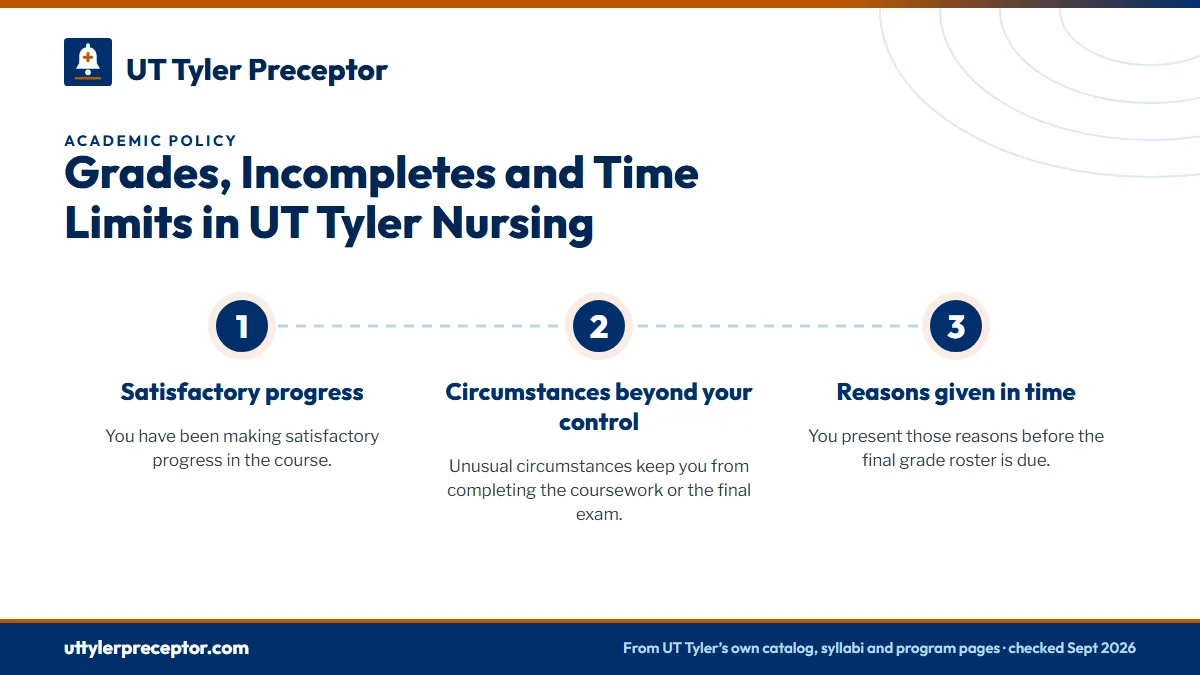
An Incomplete is the tool for a semester that goes wrong late in the term. UT Tyler's graduate policies allow an I only when all three of these hold:
- Satisfactory progressYou have been making satisfactory progress in the course.
- Circumstances beyond your controlUnusual circumstances keep you from completing the coursework or the final exam.
- Reasons given in timeYou present those reasons before the final grade roster is due.
| Incomplete (I) | In Progress (IP) | |
|---|---|---|
| Meant for | A student who falls behind for reasons outside their control | Pre-defined courses, such as internships or supervised practice, that normally run past the grading deadline |
| How it starts | The student presents reasons before grades are due | Set in advance for the course |
| Time limit | No more than one year, then the I becomes an F | Not stated in the policies reviewed |
| Interchangeable? | No | No: policy says IP does not substitute for an I |
The School of Nursing has its own Incomplete Grade Form, so raise the question with your course faculty first. No UT Tyler page says the FNP internships or any NP practicum are IP courses, so plan as though each clinical course is graded at the end of its own semester.
An Incomplete is requested before final grades are due, not after. Once the roster is in, the third condition can no longer be met.
Time limits, leave and medical withdrawal
UT Tyler measures a graduate program in years as well as credits, and the clock keeps running through slow semesters. These are the limits that apply to nursing students.
| Rule | What UT Tyler says | Where |
|---|---|---|
| Master's degrees | All degree requirements completed within six years | 2026-27 catalog, graduate policies |
| MSN coursework | Every course applied to the degree taken within six years | 2026-27 catalog, MSN |
| Doctoral degrees | Completed within nine years; the DNP program listing gives six years as its maximum | 2026-27 catalog |
| Break in enrollment | Three or more consecutive semesters away requires a readmission application | Graduate policies |
| Leave of absence | Up to one calendar year, and it stops the time-limit clock | Graduate policies |
The two doctoral figures do not match: the university's graduate policies allow nine years, while the post-master's DNP listing gives six. Ask the DNP Program Director which limit applies to your cohort before you plan a slower pace.
A formal leave of absence beats simply stepping away. Leave pauses the clock for up to a year, while three semesters without enrollment sends you back through readmission. A medical withdrawal has its own cost: you sit out one semester, and returning to clinical courses depends on space being available.
Transfer credit and course equivalency
Transfer credit is limited and reviewed course by course, and the rules for the MSN differ from those for the post-master's certificates.
- Master's transfer credit is capped at 9 hours, each earned with a B or better.
- For the MSN, the Assistant Dean for Graduate Programs approves transfer credit, and all coursework in the degree must fall inside the six-year window.
- Course equivalency (Policy 5.2) runs through the Graduate Nursing Advisor and ends with a transfer credit approval form.
- If you finished the three Ps (pathophysiology, health assessment, pharmacology) within the last three years, the post-master's FNP certificate lets a competency exam stand in for those nine hours.
- PMHNP certificate applicants have those prior courses reviewed, and combined versions of the three courses are not accepted.
Doctoral students get a different kind of credit. Approved post-baccalaureate practice hours can stand in for as much as 50% of a DNP course's practice requirement, which the DNP practice hours page explains.
Keeping a clinical course on track
Most grade trouble in a clinical course starts before the semester does, with a preceptor secured late or a site that cannot offer the patients the course calls for. The placement desk works on that front end.
Your placement advisor confirms a preceptor who matches the course population, gathers the details faculty need to approve the site, and pushes the agreement and facility onboarding so hours can begin on time. If a preceptor withdraws mid-term, we find a replacement quickly, so you and your faculty have real options to weigh before an Incomplete becomes the only one.
UT Tyler students choose us because the work is built around their own school's rules: the course hour counts, the Texas-only requirement and the approval steps. Start with the request form, or read what to do this week if a semester is close and you still have no preceptor.
Questions UT Tyler students ask
Can I get an Incomplete at UT Tyler if my preceptor drops out?
Possibly, but it is not automatic. The policy asks for satisfactory progress so far, circumstances beyond your control, and reasons presented before final grades are due. Tell your course faculty the week it happens, document the hours you have logged, and ask whether an Incomplete fits. Faculty decide, using the School of Nursing's own form.
How long do I have to finish UT Tyler's MSN?
Six years for all degree requirements, and every course applied to the degree has to fall inside that window. A leave of absence of up to a calendar year pauses the clock. Three straight semesters away without leave means a readmission application, so speak with your advisor before stepping out.
How long do I have to appeal a UT Tyler nursing grade?
The School of Nursing's timeline for course grade appeals is 10 days, according to the 2025-2026 Nursing Student Guide. Start with your course faculty, and have your clinical logs, preceptor signature sheets and CPEs ready, since clinical grades rest on those records.
Can I switch from UT Tyler's MSN Nursing Education to the FNP track?
Not as a transfer. Policy 5.1 bars students admitted to the Administration, Education or Informatics MSN from moving into the FNP or PMHNP degree programs that way. If you want to become a nurse practitioner, ask the Graduate Nursing Advisor which route the School of Nursing accepts.
Will UT Tyler count clinical hours I completed at another school?
The published transfer rules speak to course credit: up to 9 graduate hours toward a master's, each with a B or better, approved by the Assistant Dean for Graduate Programs. None of the policies reviewed addresses carrying NP clinical hours over from another program, so get a written answer from the Graduate Nursing Advisor before counting on it.
Related pages
Last checked 2026-09-25
We check these pages against UT Tyler's own catalog, syllabi, program pages and clinical policies, and Texas rules. Your course, your program coordinator and the Clinical Coordinator have the final word.
UT Tyler asks you to choose your clinical site. We find it.
Tell us your UT Tyler track, where in Texas you live and when your next clinical course starts. We find preceptors near you who fit the course and gather everything your Self-Placement Request needs, so faculty can approve it before the semester.
- Preceptors matched to the course: pediatrics for
NURS 5453, adult and geriatric care forNURS 5455, psychiatric care forNURS 5367 - Texas-licensed preceptors who clear UT Tyler's supervisor, relative and site rules
- Anywhere in Texas, from the Piney Woods to the Valley
Start your placement plan
Program, city and start date is all we need to begin.